PERENNIAL CITY: EXPERIMENTS IN URBAN GARDENING
New Exhibition at Jane Addams Hull-House Museum Traces the Roots of Chicago’s Urban Garden Movement
Opening March 19, PERENNIAL CITY: EXPERIMENTS IN URBAN GARDENING brings together new artist commissions and rare archival materials to reveal how gardeners—past and present—use land, creativity, and collective power to reimagine Chicago's urban landscape.
Chicago, IL— (January, 2026) This spring, the Jane Addams Hull-House Museum at the University of Illinois Chicago (UIC)—a museum dedicated to preserving and amplifying the social reform mission of the historic settlement house movement spearheaded in the United States by activist Jane Addams—will present Perennial City: Experiments in Urban Gardening. The exhibition, opening March 19 and on view through December 18, 2026, uncovers the deep roots of Chicago’s urban gardening movement, just before its national uptake, through the histories of immigrant communities and the Hull-House reformers who advocated for reform through the arts and collective action during the early twentieth century.
Bringing together rarely seen archival materials and new art commissions, Perennial City illuminates the garden as a powerful tool for reclaiming land beyond possession—a means for countering pressures of industrialization, commercial expansion, and today's cycles of disinvestment and gentrification. The exhibition invites visitors to see the garden not simply as a green space, but a site of regenerative sustenance, mutual benefit, and natural beauty.
Many people and organizations are trying to make Chicago’s motto ‘City in a Garden,’ a reality,” said Ross Stanton Jordan, curator of the exhibition. Perennial City looks back to the city’s earliest urban agricultural experiments as inspiration for civic garden enthusiasts and advocates everywhere.
“Working-class and immigrant Chicagoans have struggled to access stable land for growing,” said Matthew Randle-Bent, Acting Director at Hull-House. “A century ago, Hull-House proved how civic institutions could intervene to seed a more verdant, pleasant life. Reformers negotiated with landowners, opened rooftop gardens, and created rural retreats. Access to the earth was essential to building a good society, just as it is today.”
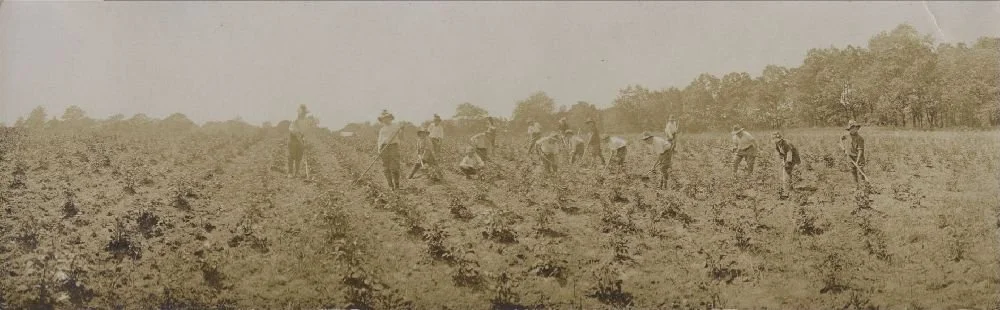
Beginning in the 1890s, as part of its broader mission to support the aspirations of working-class communities on Chicago’s Near West Side, Hull-House helped secure access to hundreds of acres of unused industrial land or neglected lots for use by immigrant groups of “landless gardeners.” Reformers understood collective gardening was a tool to restore immigrant agency in the urban landscape, encouraging gardeners to incorporate techniques and traditions from Europe while also tending native Midwestern crops. These gardens and other Hull-House programs promoted access to nature and offered relief from tenement overcrowding, airborne illnesses, and industrial pollution. The gardens sustained economies of care and good health that inspired future city planners and designers, including Danish-born landscape architect Jens Jensen, whose 1919 vision for Chicago’s Great Western Park System imagined the city encircled by urban farms and interconnected public parks.
Exhibition Highlights
Perennial City transforms the Museum’s historic interior into a site of renewal, reclamation, and rootedness, reinterpreting Chicago’s overlooked tradition of community growing. Stories of immigrant gardeners of the Progressive era come alive through historic photographs and newly surfaced gardener testimonies from the turn of the century.
A commissioned toile wallpaper by Relativity Textiles wraps the first-floor galleries, reinterpreting this visual narrative form to depict scenes from Chicago’s histories of community gardening and urban agriculture. On the second floor, visitors encounter an interactive mural and living map that brings Jen Jensen’s humanistic vision of a city linked by communal green spaces into dialogue with contemporary experiments in urban growing across Chicago’s neighborhoods.
Throughout the historic home, artistic visions of a garden city unfold.
Artist and curator Carlos Flores will bring his Porta(til) (2022-ongoing) installation to Hull-House in partnership with La Huerta Roots and Rays, an organic community garden in Chicago’s Pilsen neighborhood and a part of NeighborSpace, the only nonprofit urban land trust in Chicago that preserves and sustains gardens. Built into modified wheelbarrows, Porta(til) are mobile altars that merge the symbols of colonial missionary altars and the tools of day laborers, reimagining both as vessels of migration, survival, and spiritual labor.
Olly Costello presents Fertile Futures (2021-2024), a series of vibrant cut-paper collages that use soil and garden imagery as literal and figurative symbols for the health of social infrastructure. Olly’s illustrations are inspired by their work as a community activist, seed saver, and member of a yard-share network. Visitors will leave with packets of sunflower, pole bean, tulip, and native flower seeds from Olly’s World We Want seeds project. Each seed packet carries a meditative message and invites the public to sow seeds and intention for collective flourishing throughout the urban landscape.
Hull-House will also debut Planting Community, a series of botanical prints created by Red Line Service artists. These plant prints were created during workshops facilitated by artist and educator Melissa H. Potter. Using plants collected from the Hull-House grounds and across the city, and printed on pulp recycled by the artists, these works invite visitors to reimagine found materials from the city and its natural environs as tools for regeneration, and to rethink art as a medium for social belonging.
Programming
Throughout Spring, Summer, and Fall 2026, Hull-House will host workshops, tours, and gatherings linked to Perennial City. Taking place at the museum and fanning out across the city, programs will engage local urban gardeners, chefs, and leading urban agriculturalists. Events will connect civic-minded Chicagoans, gardeners, and activists to explore gardening, gentrification, sustainable foodways, environmental justice, and land insecurity.
Support
Perennial City: Experiments in Urban Gardening is supported by the Efroymson Family Fund.
Public programs are supported by the National Endowment for the Humanities, Climate Smart Humanities Organizations initiative. The partnership between Jane Addams Hull-House Museum and Red Line Service is supported by the Terra Foundation for American Art. Perennial City is supported by generous donors to the museum's annual Neighborhood Social.
Featured Artists
Carlos Flores is an interdisciplinary artist, curator, and flower farmer born in the Lands of Atemajac (Guadalajara) and now living in Shikaakwa (Chicago). Since 2014, his art practice has produced interventions on the Southwest Side of Chicago addressing environmental justice, displacement, and migration. In 2023, as Chicago Park District Curator-in-Residence, Flores worked with design firm Human Scale to create and activate a new pavilion structure in Marquette Park, one of the city’s largest green spaces, providing a platform for neighbors and artists to reclaim public space. Flores founded Contra Corriente in 2022, an annual artist-run festival that connects artists, environmentalists, and community organizers to resist environmental racism through exhibitions and interactive programs. Flores is the director of programs at the Chicago Art Department (CAD), a community art center in Pilsen. Annually, CAD provides space and resources for twenty civically minded artists through a yearlong residency program, alongside exhibitions and public programs.
Olly Costello is a queer illustrator, muralist, urban food growing enthusiast, and community seed saver. They help coordinate the Rogers Park Seed Library, a free resource of vegetable and native plant seeds for the city and have painted several murals on the north side of Chicago. For over fifteen years, Olly has been growing food as a part of a yard-sharing project, where private landowners share their unused yard space with neighbors who otherwise don’t have access to growing space. They illustrated Prisons Must Fall by Mariame Kaba and Jane Ball (Haymarket Books, 2025), a children’s book that presents solutions to harm that do not involve incarceration with an emphasis on practicing compassion, meeting people’s basic survival needs, restorative justice practices.
Led by people with a lived experience of homelessness, Red Line Service wields art world resources to build community, generating the sense of belonging and mutual care essential to securing and retaining housing. We collaborate with artists and cultural institutions to expand access to the art world, avowing that art can break the bonds of ingrained social roles and structures and forge new realities in which all can flourish. Red Line Service is the only art organization in Chicago—and one of the only art organizations world-wide—led by people experiencing Houselessness.
Melissa H. Potter is a feminist interdisciplinary artist, writer, and curator whose work has been exhibited in numerous venues including White Columns, Bronx Museum of the Arts, and Museum of Contemporary Art Chicago. Potter has been the recipient of three Fulbright Scholar grants. She is a Professor at Columbia College Chicago and collaborates with artists in the medium of hand papermaking.
